 Mitgliederbereich
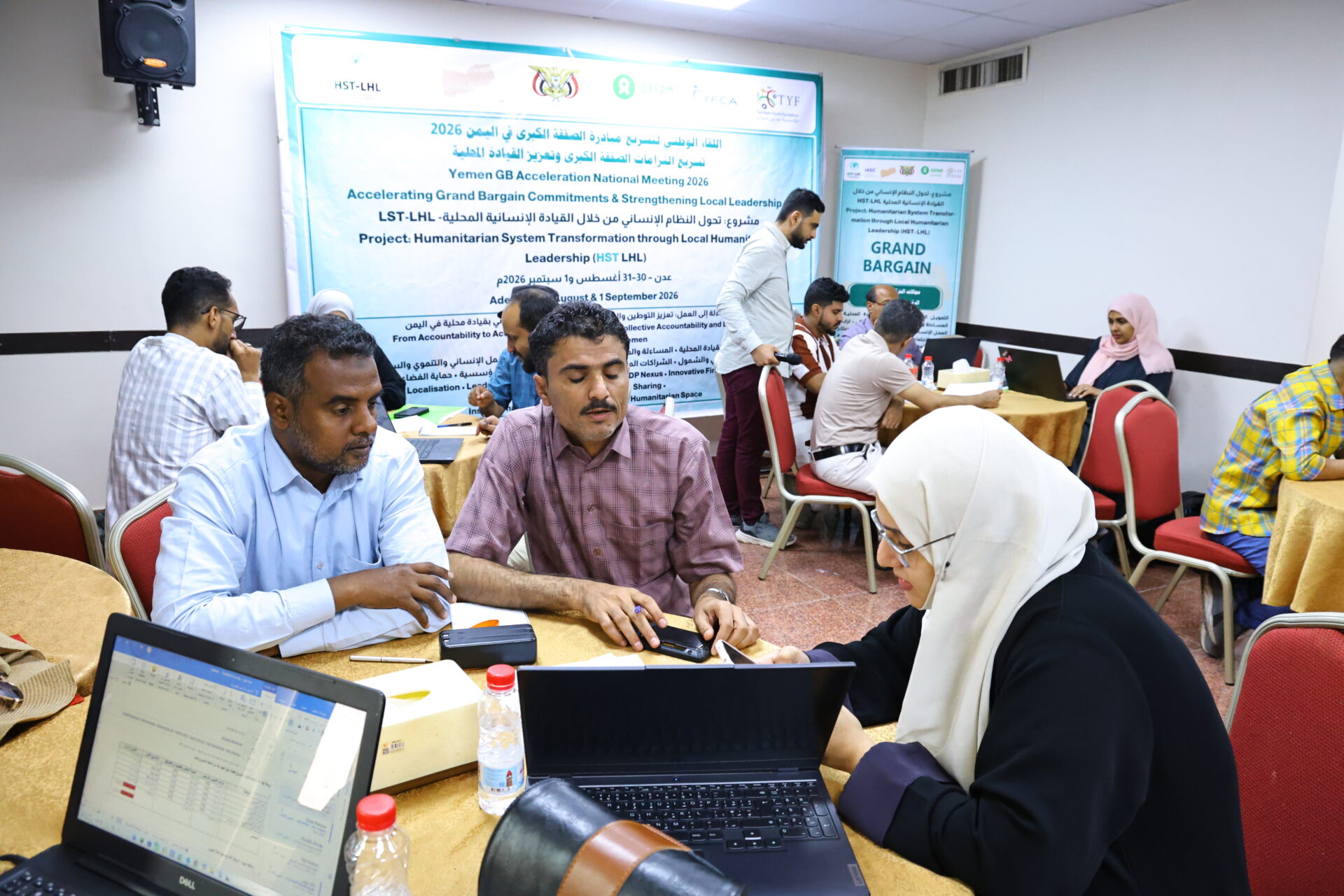
In Yemen, the word for „localisation“ is often understood to mean the settlement of foreign populations. The „Grand Bargain“ sounds like a commercial transaction. These are not minor linguistic quirks – they reveal how humanitarian reform can lose its meaning the moment it crosses into a new language and culture. Drawing on consultations with local actors in Yemen, I reflect on why genuine localisation must begin with the words we use.
My name is Abdulqawi Hajeb. I coordinate the Yemen Localization Initiative and facilitate the Yemen National Reference Group (NRG). Through workshops and ongoing engagement with local non-governmental organisations (NGOs), community-based organisations (CBOs), women’s groups, and youth initiatives, one finding has become increasingly clear: Language is one of the most overlooked barriers to genuine localisation.
Humanitarian concepts are typically developed within international institutions and later translated into national languages. These translations are often linguistically accurate, yet they do not always convey the intended meaning within local contexts. In Yemen, the difficulty is rarely the Arabic language itself – it is the absence of conceptual localisation. A term can be translated correctly and still be misunderstood entirely.
When Accurate Translation Still Misleads
Few terms illustrate this better than localisation itself. Its common Arabic translation, al-Tawṭīn, is widely associated in Yemen with the settlement of foreign populations or demographic change. Several participants told me that when they first encountered the „localisation agenda,“ they assumed it referred to something close to the opposite of its intended purpose.
The Grand Bargain raises a similar concern. Translated literally, al-Ṣafqah al-Kubrā is generally understood as a political or commercial deal. As one participant observed, it „sounds like a transaction between powerful actors, not a global humanitarian reform movement“ – a name that communicates little of the partnership or shared accountability it is meant to represent.
The National Reference Group is technically accurate in translation but carries limited meaning outside coordination circles; participants frequently asked, „reference for whom?“ Decolonisation, meanwhile, is understood literally as ending colonial occupation, and remains unfamiliar to many Yemeni practitioners, often perceived as external political terminology rather than a relevant humanitarian framework.
Taken together, these examples point to a consistent pattern: Literal translation preserves the words, but not always the intention behind them.
Contested Categories
Some terms proved difficult not because of translation, but because of definition. Local actors, for instance, generated considerable discussion: Are only formally registered NGOs considered local? What about community-based organisations, organisations of people with disabilities, faith-based groups, or traditional community institutions – many of which have provided leadership during crises for generations, often with deeper community trust than more recently established structures? Participants argued that locality should be defined by legitimacy and proximity to affected communities, not registration status alone.
Capacity building raised a related question: Why is this concept applied almost exclusively to local organisations, when donors, UN agencies, and international NGOs also require greater capacity in equitable partnership and contextual understanding? Terms such as mutual learning and capacity strengthening were seen as more balanced alternatives.
Values That Already Exist
Perhaps the most significant finding from these consultations was that humanitarian principles are not foreign to Yemeni society. Communities already hold well-established concepts that express solidarity, consultation, and collective responsibility –among them al-Shūrā (collective consultation), al-Takāful (mutual social solidarity), and al-Nakhwah (honourable solidarity), which closely mirrors the humanitarian principle of humanity. These frameworks often carry deeper ethical and social meaning than the international terms introduced to describe them.
Genuine localisation, then, is not a matter of introducing humanitarian values to local communities. It is a matter of recognising and building upon systems of knowledge and solidarity that already exist.
Conclusion
Terminology deserves far greater attention in discussions on localisation and decolonisation. The task is not simply to translate English terms into Arabic, but to ensure that humanitarian concepts are expressed in language that is culturally meaningful and genuinely understood by those expected to engage with them.
If humanitarian reform is to place local actors at the centre of the system, those same actors should help shape the language that defines it. This requires testing new terminology with local communities before it is promoted globally, involving local organisations directly in its development, and allowing space for contextual flexibility – since shared global principles do not require identical terminology in every setting.
Ultimately, localisation is not only about who leads humanitarian action. It is also about how that action is described, understood, and owned.
About the author: Abdulqawi Hajeb coordinates the Yemen Localization Initiative and facilitates the Yemen National Reference Group (NRG), supporting local actors in shaping response policy reform in Yemen.
| Abdulqawi Hajeb |  |
Yemen Localisation Initiative |
Die Inhalte auf dem VENRO-Blog geben Meinungen und Einschätzungen unserer Autor_innen wieder. Sie können von abgestimmten VENRO-Positionen abweichen.