 Mitgliederbereich
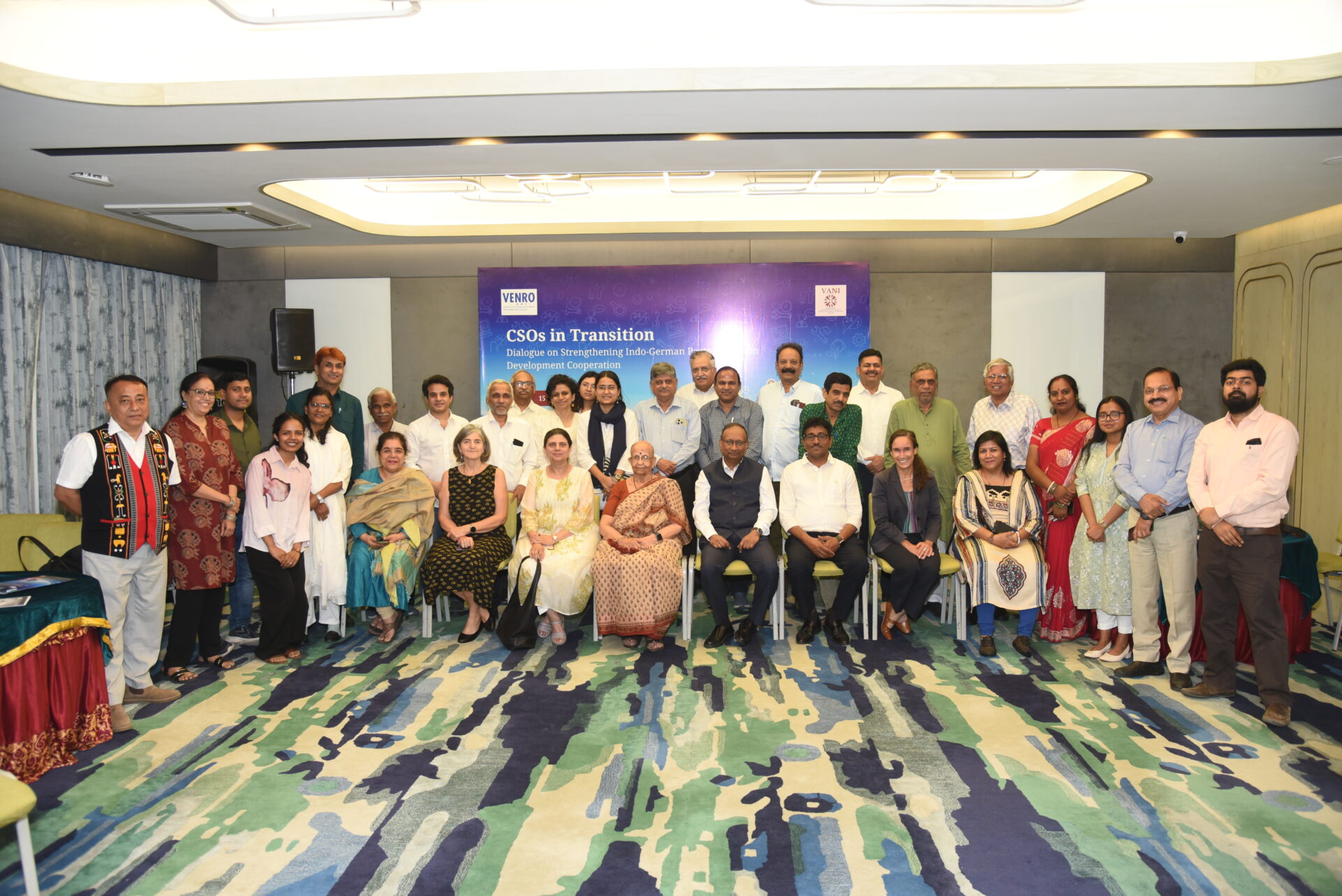
How can civil society build stronger partnerships for the future? As global challenges reshape development cooperation, Indian and German stakeholders met in Delhi to explore more equitable collaboration and sustainable solutions.
Indo‑German development cooperation stands at a turning point – one that carries both challenges and opportunities. At a roundtable in New Delhi, Indian and German civil society organisations, embassy representatives, and Corporate Social Responsibility (CSR) stakeholders came together to reflect on how partnerships can remain equitable, relevant, and effective in a rapidly changing environment.
This dialogue built on an earlier exchange convened by VENRO in Berlin, where civil society partners discussed new opportunities to strengthen civil society collaboration amid shrinking development aid, increasing geopolitical pressure, and domestic challenges.
The Delhi roundtable was therefore not an isolated event but part of a continuing process of mutual learning, reflection, and coalition‑building. It was held on 15–16 April 2026 under the VANI-VENRO collaborative project Countdown 2030 – Global Goals need Civil Society.
Why this conversation mattered
Indian Civil Society Organisations (CSOs) form one of the world’s most vibrant sectors, contributing to nation-building and socio-economic development. Yet they increasingly operate within a shrinking civic space, marked by depleting resources and complex compliance burdens.
These domestic compulsions and global pressures affect how CSOs engage with international partners and access domestic CSR resources. At the same time, expectations of CSOs from communities and policymakers remain high. India and Germany share a long history of cooperation in the field of industrial, scientific, and social collaborations in which civil society has been central – yet, grassroots organisations increasingly struggle to participate in and fully benefit from these partnerships.
CSOs in transition: From trust‑based to rule‑bound partnerships
Discussions on Day 1 centred on how relationships once shaped by flexibility, trust, and vision are now constrained by shorter project cycles, heightened compliance requirements, and greater administrative burdens. CSR emerged as an alternative funding avenue, but access remains uneven: smaller organisations rooted in remote communities face capacity barriers despite their strong local presence. Participants called for better facilitation between companies and CSOs, and for sustained capacity‑building to ensure more equitable partnership models.
Building a stronger support ecosystem
The second day shifted focus to solutions. Participants proposed that VANI and VENRO act as a bridging platform between German CSOs, German companies, and Indian CSOs, complemented by structured dialogues and greater visibility of civil society’s contributions. Capacity‑building was seen as crucial – particularly in relation to legal frameworks, compliance, reporting, proposal writing, and digital tools, including newer funding mechanisms such as the Social Stock Exchange.
At the same time, participants acknowledged that these efforts must be situated within a wider global context to promote cross-learning and collaborations. Across many countries, common trends can be observed regarding the enabling environment and the absence of support ecosystems. The participants visualised that an important outcome of this collaboration could be the creation of an environment for mutual learning, shared documentation, and the articulation of common knowledge across continents through Countdown 2030 partners.
The participants also expressed the need to develop a positive public narrative of the CSOs by documenting the challenges and achievements. VANI’s ongoing work resonated strongly – like developing compendiums, updates and support literature on compliance, and hand‑holding support for grassroots organisations. Participants encouraged VANI to expand this foundation through local resource centres, overcoming regional language barriers and producing popular literature like newsletters and booklets with the ultimate aim of reaching those who need it most.
Looking ahead
The most significant outcome was that the roundtable did not end with conclusions but opened a wider process of reflection, coalition‑building, and future collaboration. The recommendations will now guide the next phase of Indo‑German partnership engagement. In this sense, the dialogue was both a reflection on the present and a deliberate step towards the future – a turning point at which civil society can seize opportunities for innovation, solidarity, and constructive engagement.
Crucially, as civic space continues to shrink worldwide, Indo‑German cooperation offers a pathway to counter these pressures by reinforcing openness, building resilience, and ensuring that civil society remains a vital force for justice and sustainable development.
Subhashini Prabhaker works as Programme Officer at our Indian partner VANI.
Civil society actors play a key role in strengthening and shaping sustainability discourses about the future of the 2030 Agenda at the multilateral level. As part of the Countdown 2030 project, VENRO, together with development and humanitarian networks from Brazil (ABONG), Ethiopia (CCRDA), and India (VANI), seeks to shape these debates and help strengthen sustainability issues in multilateral processes. Learn more about our joint project here.
| Subhashini Prabhaker |  |
VANI |
Die Inhalte auf dem VENRO-Blog geben Meinungen und Einschätzungen unserer Autor_innen wieder. Sie können von abgestimmten VENRO-Positionen abweichen.